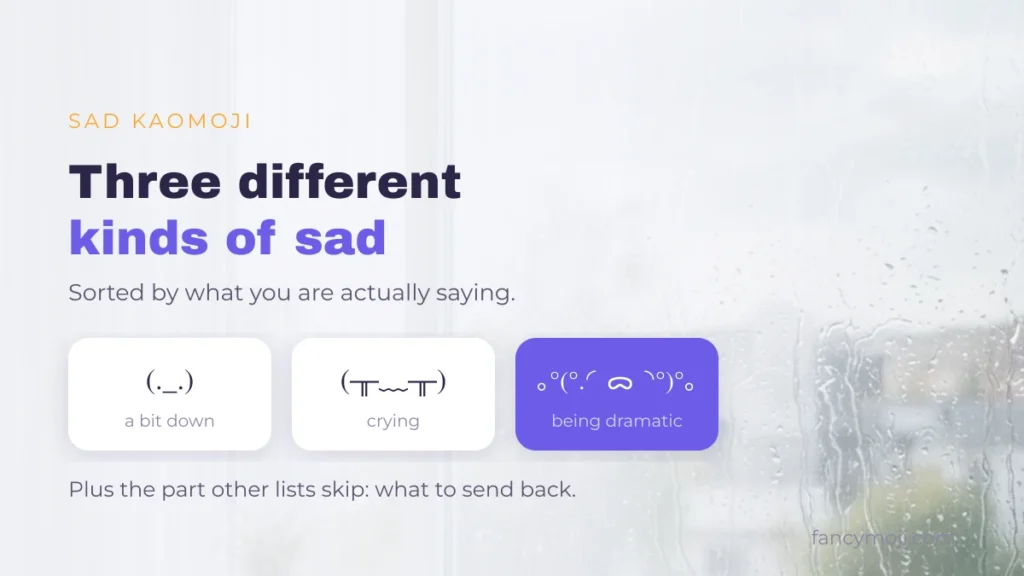
There are three different things people mean by a sad face, and sending the wrong one changes the message. «I am a bit down» is not «I am crying» is not «I am being dramatic for comic effect». The groups below are sorted by what you are actually telling someone, and the last section is the one no other list has: which face to send back when someone else is the sad one.
tap one to copy it. an empty box means your device is missing a font for that character — the text still copies correctly.
Quietly sad
Understating it on purpose. These are what people actually send when something is wrong but they do not want to make it a whole conversation.
| Face | What it reads as |
|---|---|
| (ᴗ_ᴗ.) | downcast |
| (´•︵•`) | small sad |
| (´・_・`) | unsure |
| (•ᴗ•,, ) | holding it in |
| (個_個) | quiet cry |
Actually crying
The tear marks — ╥ ﹏ ಥ T — do all the work here. Read as sincere rather than performed.
| Face | What it reads as |
|---|---|
| (╥﹏╥) | big tears |
| (,,╥﹏╥,,) | streaming tears |
| (T_T) | classic tears |
| (´;ω;`) | welling up |
| ( 。•̥ ω •̥ 。) | sniffle |
Dramatically sad, on purpose
Oversized enough that everyone knows it is a joke. Useful precisely because they are not subtle: nobody worries when you send one.
| Face | What it reads as |
|---|---|
| 。°(°.◜ᯅ◝°)°。 | full wail |
| (ノд`) | hiding tears |
| ପ(๑' ཪཀ๑)ଓ | distressed |
| (`ε´) | pouty mad |
| (˶ > ₃ < ˶) | pouting hard |
Sad animals
The most-searched corner of this whole category, and the softest way to say you are upset.
| Face | What it reads as |
|---|---|
| (=TェT=) | crying cat |
| (=;ェ;=) | teary cat |
| ʕ´• ᴥ•̥`ʔ | teary bear |
| ໒꒰ྀི˶╥︿╥꒱ྀི১ | crying bunny |
Disappointed, not crying
A different feeling entirely, and the one people reach for wrong. Nothing here is sad — it is over it.
| Face | What it reads as |
|---|---|
| ¯\_(ツ)_/¯ | shrug |
| ╮(╯_╰)╭ | big shrug |
| ┐(´~`)┌ | shoulder shrug |
| ¯\_(- > -)_/¯ | resigned shrug |
| (⎚-⎚) | deadpan |
More tearful faces
The rest of the crying set, for when none of the above is quite it.
Small moods: blushing, shy, smug, pouting and sleepy
Sadness comes in smaller shapes too. These are the in-between faces for when you are embarrassed, withdrawn, sheepish, sulking or just tired.
Blushing through the tears
Embarrassed and close to crying at once. It is what a flustered apology looks like.
Shy and down
Quiet and a little low. Good when you do not want to explain.
Smug, then sorry
The face after teasing someone a bit too far.
Pouting sadly
A sulk that is closer to hurt than to annoyed.
Sleepy and sad
Tired of being sad. Often sent late at night.
What to send back
This is the half every sad-kaomoji list leaves out, and it is the half people need more often. When a friend sends you one of the faces above, a matching sad face is not usually the right reply — it reads as agreeing that things are bad. These do something different: they offer.
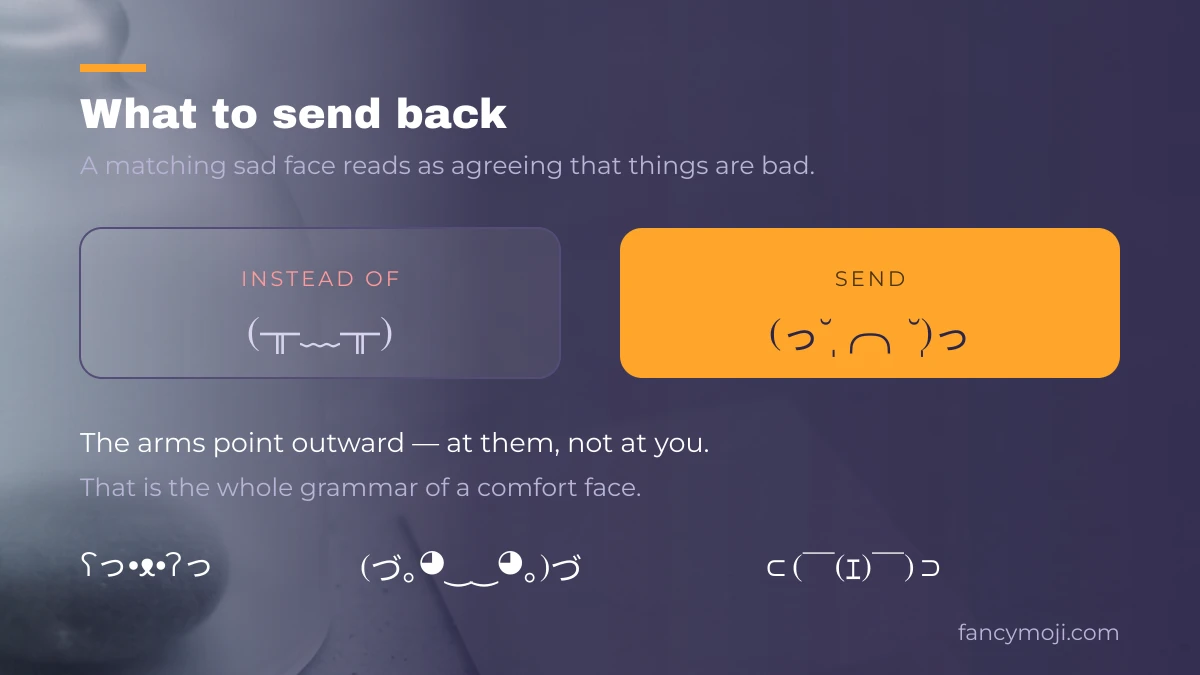
The reaching ones — (っ˘̩╭╮˘̩)っ and ʕっ•ᴥ•ʔっ — are the closest thing text has to a hug, because the arms are pointing outward at the person reading. That is the whole grammar of it: arms out means the gesture is aimed at them, not at you.
Marks that pair with a sad face
A face on its own is a reaction; a face with a mark either side becomes a mood. These are the ones that fit this end of the library — rain, wilted things, and the very small quiet marks people use as breathing room.
Rain and clouds
Wilted and falling
Quiet marks and dividers
Almost invisible on purpose. Put one either side of a face and the whole line slows down.
A few more faces
Pairing rule that holds up: one mark, one side, or one mark on each side — never more. A sad face crowded with decoration stops reading as sad and starts reading as a graphic.
How to read a sad face before you send it
Kaomoji are assembled from parts, and with sad ones a single character decides whether you sound genuinely upset or obviously joking. Three positions matter.
| Position | Written as | What it does |
|---|---|---|
| Eyes | ╥ ಥ T ; | These are the tears. Swap them into any face and it starts crying. |
| Mouth | ﹏ ︵ ╭╮ ﹃ | Downturned. The wider it is, the more the face is performing. |
| Cheeks | ,, 。 ˚ | Small marks beside the eyes read as wobbling. They soften a face rather than sadden it. |
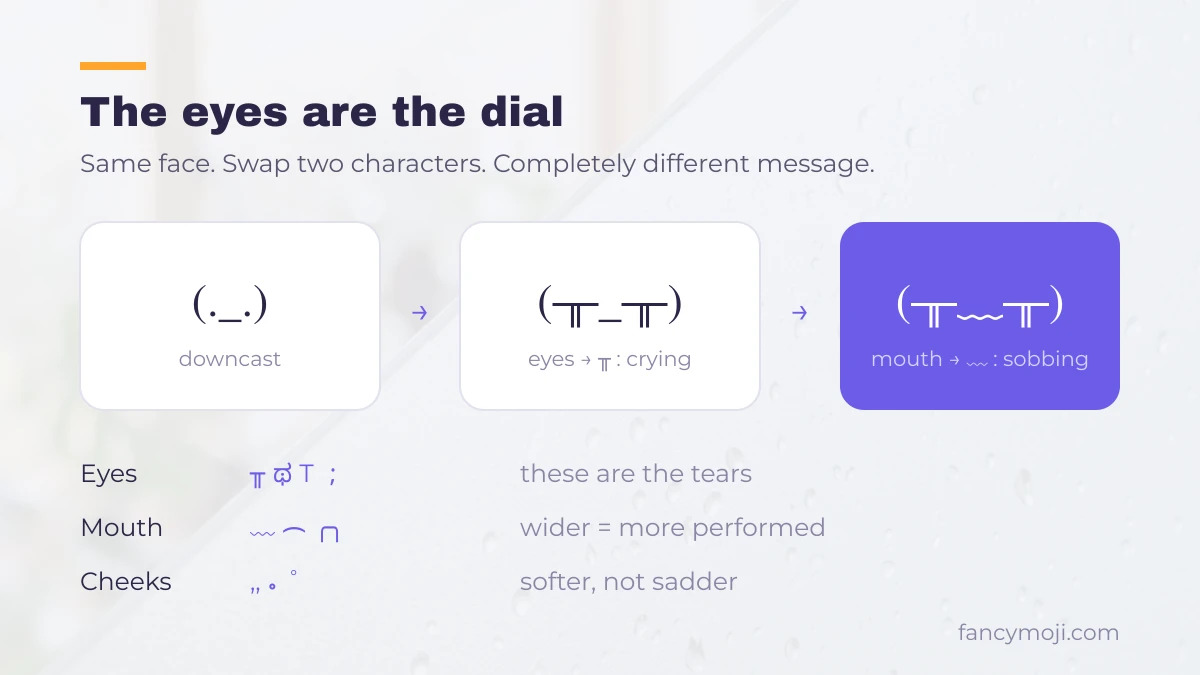
That gives you a dial rather than a list. Take (._.), swap the eyes for ╥ and you get (╥_╥) — same face, entirely different message. Widen the mouth to ﹏ and it becomes (╥﹏╥), which is the one people actually recognise as crying.
When a sad face helps and when it does not
A text face carries tone that plain words lose, which is genuinely useful — «ok» and «ok (._.)» are not the same message. But the same quality makes them wrong in some places.
- Good for softening a small disappointment. «cant make it tonight (´•︵•`)» reads as regret. Without the face it reads as indifference, which is not what you meant.
- Good for taking the edge off your own bad news, when you do not want the other person to have to manage your feelings.
- Bad for anything serious. Real grief, an apology that matters, bad news about a person — a face makes it look like you reached for decoration instead of words. Silence is better than a kaomoji there.
- Bad when the other person is the one hurting. Send the comfort ones above, or nothing. Matching their sad face can read as competing with it.
If it arrives as empty boxes
Sad kaomoji break more often than happy ones, and there is a reason. The characters that make good tears — ಥ from Kannada, ཀ from Tibetan, ᯅ from Batak — come from scripts that many devices do not ship fonts for. The face is fine; the device simply cannot draw those letters.
If a face has to reach someone on an unknown device, take one built from ordinary punctuation and kana instead: (T_T), (._.) and (╥﹏╥) render almost everywhere. The exotic ones are best kept for places where you can see how they land.
Frequently asked questions
What is the sad Japanese emoticon?
There is no single one, but (T_T) and (╥﹏╥) are the two most widely recognised. The first is older and plainer; the second reads as crying harder.
What does ╥ mean in a kaomoji?
It is a tear. It is a box-drawing character borrowed for the shape, which is why it appears in almost every crying face — the vertical stroke reads as a tear running down.
How do I make a crying face myself?
Take any face and replace its eyes with ╥, ಥ or T. The eyes are what carry the emotion, so changing them alone is enough.
Are there sad cat and bunny kaomoji?
Yes — they are in the animals group above. The ears (= = for a cat, ໒ ১ for a bunny) stay the same and only the eyes change to tears.
What should I send when someone else is sad?
One of the faces in the last section, with arms reaching outward. A matching sad face tends to read as agreement rather than support.
Where are the other moods?
The cheerful end of the library is in cute kaomoji, the loud end is the Lenny Face, and how the faces are put together in the first place is explained in what a kaomoji is. Everything sorted by feeling lives on Fancymoji.