welcome to the meadow. tell us how you're feeling and we'll walk out the little ones who match. tap any one to take it home.
A kaomoji (顔文字, Japanese for "face characters") is an emoticon built from ordinary text characters and read upright, without tilting your head — (◕‿◕) ¯\_(ツ)_/¯ ʕ•ᴥ•ʔ. Unlike an emoji it is not a picture: it is plain Unicode text, so you can paste it into Discord, a TikTok display name, or an Instagram bio.
(◕‿◕)gentle smile
ヽ(・∀・)ノlittle cheer
(^▽^)big grin
(´。• ᵕ •。`)shy joy
(*^▽^)/wave hello
ヽ(´▽`)/arms up
(☆▽☆)starry eyes
(๑˃ᴗ˂)ﻭcheer fists
(◍•ᴗ•◍)warm cheeks
( ˶ˆ꒳ˆ˵ )quiet delight
(✿◠‿◠)flower smile
٩(◕‿◕)۶hooray
(っ˘ω˘ς )cozy content
(。•̀ᴗ-)✧wink and go
(♡˙︶˙♡)smitten
(。♥‿♥。)heart eyes
(づ。◕‿‿◕。)づbig hug
♡(◡‿◡✿)loved
(´♡‿♡`)in love
(灬º‿º灬)♡bashful love
(づ ̄ ³ ̄)づkiss blow
♥(ˆ⌣ˆԅ)smooch
(◍•ᴗ•◍)❤heartfelt
ლ(´ ❥ `ლ)yearning
(╥﹏╥)big tears
(´;ω;`)welling up
(ಥ﹏ಥ)streaming tears
(ノд`)hiding tears
( 。•̥ ω •̥ 。)sniffle
(個_個)quiet cry
(._.)downcast
(T_T)classic tears
(っ˘̩╭╮˘̩)っneed a hug
( ˚ ˃̣̣̥⌓˂̣̣̥ )trembling
(╯°□°)╯︵ ┻━┻table flip
┻━┻ ︵ヽ(`Д´)ノ︵ ┻━┻double table flip
ヽ(`Д´)ノshouting
(╬ಠ益ಠ)furious
(`Д´)grr
(ノಠ益ಠ)ノ彡┻━┻rage flip
(#`Д´)steaming
(`ε´)pouty mad
┬─┬ノ( º _ ºノ)table back
ヽ(o`皿′o)ノmelt down
(・_・?)huh
(⊙_⊙)wide eyes
( ̄~ ̄;)hmm
¯\_(ツ)_/¯shrug
┐(´~`)┌shoulder shrug
╮(╯_╰)╭big shrug
(´・_・`)unsure
(°ロ°)startled
( ˘・з・)meh whistle
(・∀・)blank grin
\(^o^)/hurray
ヽ(≧∀≦)ノparty joy
(ノ◕ヮ◕)ノ*:・゚✧sparkle throw
。:.゚ヽ(*´∀`)ノ゚.:。confetti
o(≧▽≦)othrilled
٩(๑❛ᴗ❛๑)۶woo
(ノ´ヮ`)ノ*: ・゚toss sparkles
٩(。•́‿•̀。)۶pumped
( ̄o ̄) zzZsnoozing
(-_-) zzzdozing
(´ぅω・`)sleepy eyes
( ˘ω˘ )peaceful sleep
(。-ω-)zzzcurled up
(∪。∪)。。。zzzlong nap
ʕ•ᴥ•ʔclassic bear
ʕ ·ᴥ· ʔsitting bear
ʕっ•ᴥ•ʔっbear hug
ʕ ᵔᴥᵔ ʔhappy bear
ʕノ•ᴥ•ʔノ ︵ ┻━┻bear flip
⊂( ̄(エ) ̄)⊃reaching bear
ʕ•̀ω•́ʔ✧determined bear
(=^・ω・^=)whiskers cat
(=^・ェ・^=)sitting cat
ฅ(^・ω・^ฅ)paw cat
(=①ω①=)big eye cat
(=TェT=)crying cat
~(=^‥^)ノwaving cat
(=ↀωↀ=)✧fancy cat
(=;ェ;=)teary cat
/(・×・)\bunny ears
(•ㅅ•)little bunny
(๑•ㅅ•๑)shy bunny
('ㅅ')plain bunny
(„• ֊ •„)peeking bunny
(´・ᴗ・`)
no little ones match that — maybe one of these?
strays from further afield
the pens — by feeling
every mood gets its own shelf. give it a scroll — some little ones are shier than others.
196 faces we sorted through and kept this week, on top of the ones already in the pens. tap any of them to copy. they are stored exactly as we found them — nothing tidied up, nothing simplified.
the soft ones
rounded cheeks, half-closed eyes, no sharp edges. these are the ones people put in an instagram bio or send when a friend needs something gentle.
the bright ones
raised arms, wide eyes, exclamation energy. good for a reply that needs to read as genuinely pleased rather than polite.
the teary ones
streaming eyes and wobbling mouths. the internet uses most of these for small dramatic sorrows — a sold-out concert, a dead battery — not real grief.
the unimpressed ones
flat eyes, straight mouth, zero enthusiasm. the deadpan register — perfect for group chats where a plain "ok" would read as rude.
the spirited ones
fists up, brows down, sleeves rolled. use them for mock outrage and for genuine "let's go" encouragement — the same faces carry both.
bears, cats & company
the ʕ ʔ bracket makes a bear, the ₍^ ^₎ makes a cat. swap what sits between the brackets and you have a whole species.
what is a kaomoji?
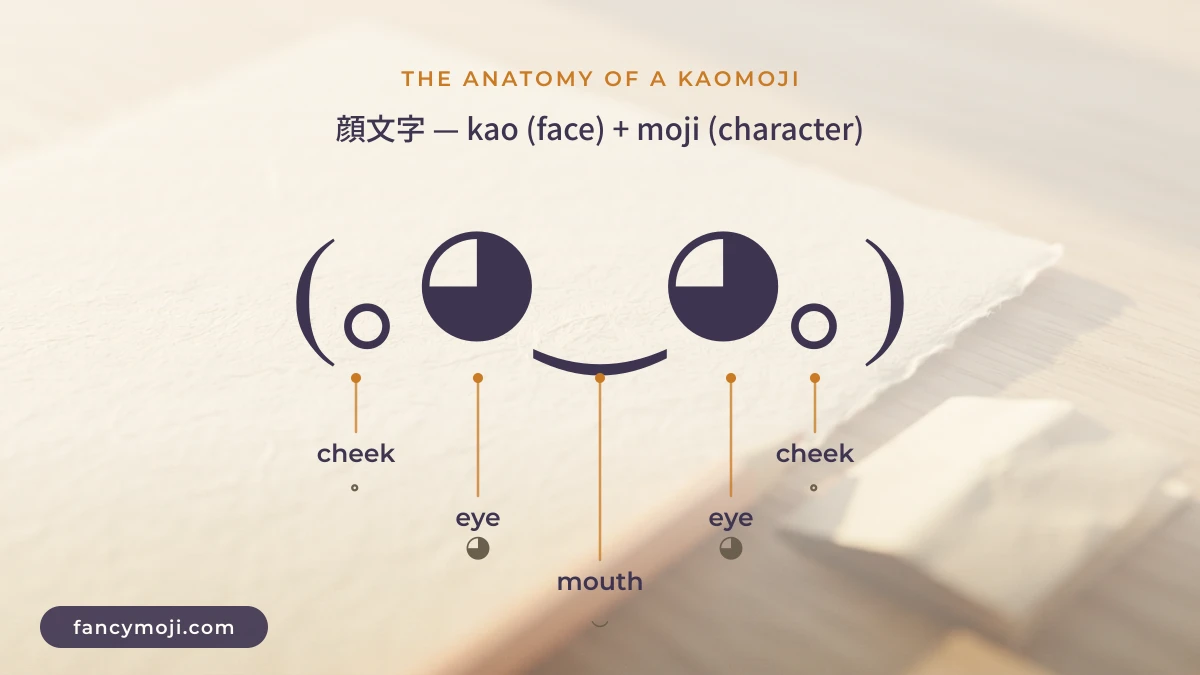
a kaomoji is a face you read upright, assembled from characters that were never meant to be a face. the word is japanese — 顔文字 — and it is literally two words stuck together: 顔 (kao, "face") and 文字 (moji, "character"). face characters.
they turned up in japan in the 1980s, on an early online service called ASCII NET, and the original (^_^) is credited to yasushi wakabayashi in 1986. the western emoticon had appeared a few years earlier and went the other way: :-) asks you to tilt your head. kaomoji never do. that one decision is why they could keep growing — a sideways face has two eyes and a mouth to work with, an upright one has cheeks, arms, ears and a tail.
the character set grew with the technology. first plain ascii, then shift jis — which opened up hiragana, katakana, kanji, greek and cyrillic — and today unicode, which is why a modern face can borrow a letter from kannada for an eye and a box-drawing character for a table. none of it is a picture. every face on this page is text, which is the whole reason you can paste it into a bio and it keeps working.
the same four slots — cheeks, eyes, mouth, arms — sit behind almost every face in the meadow.
kaomoji vs emoji vs emoticon
the three get used interchangeably and they are not the same thing. an emoji is a picture your device draws for you. an emoticon and a kaomoji are both made of characters you could have typed yourself — the difference between those two is which way up you read them.
property
kaomoji 顔文字
emoticon
emoji
example
(。◕‿◕。)
:-)
🙂
what it is
text characters
text characters
a picture character
how you read it
upright
sideways — tilt your head
upright
where it started
japan, 1980s
usa, 1982
japan, late 1990s
looks the same everywhere?
yes — the shapes are fixed
yes
no — every platform draws its own
needs font support
yes, across several scripts
no, plain ascii
yes, an emoji font
can you edit it by hand
yes, character by character
yes
no
the practical consequence is the last row. an emoji is drawn by whoever made your phone, so the same code point is a different little yellow face on ios, android and windows. a kaomoji has no artwork to disagree about — the shapes are the characters themselves, so what you send is what they see.
inside a kaomoji — the exact characters
this is the part most kaomoji lists skip. a face is not one symbol, it is a small pile of them borrowed from scripts that have nothing to do with each other. we counted the characters in the best-known faces and looked up where each one comes from — the counts below are measured from the faces on this page, not typed in by hand.
face
name
characters
borrowed from
( ͡° ͜ʖ ͡°)
lenny facethe eyebrows are combining marks — they sit on top of the degree signs rather than beside them.
look of disapprovalboth eyes are the kannada letter ttha, borrowed purely for its shape.
3
Kannada, Basic Latin
ʕ•ᴥ•ʔ
bearthe ears are glottal stop letters from the phonetic alphabet; the snout is a small capital h.
5
IPA Extensions, General Punctuation, Phonetic Extensions
(╥﹏╥)
cryingthe wobbling mouth is a wavy low line meant for vertical japanese text.
5
Basic Latin, Box Drawing, CJK Compatibility Forms
that character count matters more than it looks. ¯\_(ツ)_/¯ reads as five marks and costs 9 characters — and an instagram bio stops at 150. a face is rarely the thing that breaks a bio, but two of them plus a line of text can be. block names follow the official unicode block list.
where kaomoji work — and where they don't
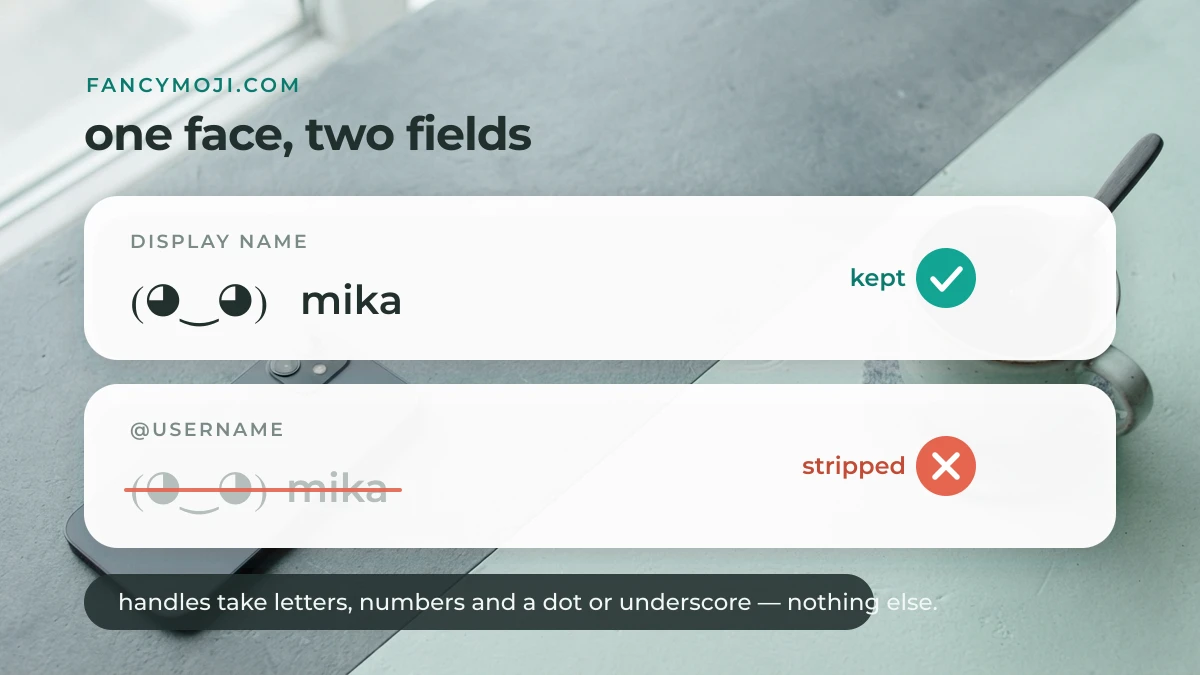
a face pastes into almost any message box on earth. the place it reliably fails is the @handle — the short unique name in your profile url. nearly every platform restricts that field to plain letters, numbers and a couple of punctuation marks, and a kaomoji is none of those things. your display name, the one shown in bold above it, is usually wide open.
same face, two fields — the display name keeps it, the handle throws it away.
platform
in a message
in your bio
in your @username
discord
yes
yes
no — usernames allow lowercase letters, numbers, _ and . only
instagram
yes
yes
no — usernames allow letters, numbers, periods and underscores
tiktok
yes
yes
no — usernames are 2–24 letters, numbers, _ and .
x / twitter
yes
yes
no — handles allow letters, numbers and underscores
whatsapp
yes
yes
not applicable — there is no @handle
most game clients
yes
sometimes
usually no — many name filters reject anything outside ascii
checked july 2026. if a face disappears the moment you save a profile, that is the platform stripping characters it will not store — shortening the face rarely helps, but moving it from the username field to the display name almost always does.
how to type kaomoji
copying from here is the fast way, and for anything with combining marks it is the only reliable way — those characters are not on any keyboard. but two of the four big systems have a kaomoji picker built in already:
windows — press the windows key and full stop together. the emoji panel that opens has a kaomoji tab, marked with a small ;-) icon.
mac — control + command + space opens the character viewer, which searches by name.
android — gboard keeps a kaomoji tray beside the emoji picker.
iphone — there is no built-in tray, so save your favourites under settings › general › keyboard › text replacement and type a short trigger instead.
if a face arrives as an empty rectangle, nothing is broken and nothing is corrupted — the reader's device simply has no font covering that character, so it draws a placeholder box. it is a rendering gap on their end, not a mistake in the face. plain-bracket faces like (^_^) survive absolutely everywhere; the ornate ones with combining marks are the ones that occasionally land as boxes on older phones.
the nursery
build one from scratch — pick cheeks, eyes, a mouth, and a pair of arms. or let us surprise you.
ヽ。•ω•。ノ
your little one
pick the pieces
tap a piece to drop it into the crib and copy it · hold (or right-click) to save it on its own
my companions
your little family, saved right here on this device.
(╥﹏╥)
nothing here yet — tap the ♡ on any little one to bring it home.
most adopted today
counted right on this device, no server involved.
care guide
a face built entirely from text characters and read upright, with no picture and no image file — (◕‿◕), ʕ•ᴥ•ʔ, ¯\_(ツ)_/¯. the style started in japan in the 1980s and borrows freely from japanese kana, cyrillic, thai, greek and box-drawing characters — whatever glyph looks right for the expression.
it is two japanese words joined together: 顔 (kao) means face and 文字 (moji) means character. 顔文字 is literally "face characters", which is exactly what they are — a face spelled out of characters rather than drawn.
no. an emoji is a picture your device draws, so 🙂 looks different on an iphone, an android and a laptop. a kaomoji is text, so the shapes are the characters themselves and everyone sees the same face you sent. an emoticon like :-) is also text, but you read it sideways — kaomoji are read upright.
in your display name, yes — that field accepts them on discord, instagram, tiktok and x. in the @username itself, no: those fields are limited to letters, numbers and a couple of punctuation marks, so a face will either be rejected or silently stripped. put it in the display name or the bio instead.
mostly, yes — but it depends on the reader's device and its installed fonts. a very old phone might show a small box instead of a character. we've checked these across chrome, safari, android and ios, but we can't promise every device on earth.
a screen reader spells out every character in a face rather than reading it as one picture, which can get noisy. every card on this site carries a plain-english aria-label (like "gentle smile") instead, so assistive tech reads the name, not the symbols. if you're using kaomoji in your own bio, a little restraint goes a long way.
on iphone: settings → general → keyboard → text replacement — save a face against a short trigger word. on android, gboard has a built-in kaomoji tray right next to the emoji picker. either way, adopting a few favorites here first makes that setup quicker.
no. kaomoji are internet folk culture — nobody owns them, and we're not affiliated with any company, keyboard, or app that also uses them.
yes. they're public folk characters, free to use however you like. we'd just gently suggest reading the room before a table flip in a work email.