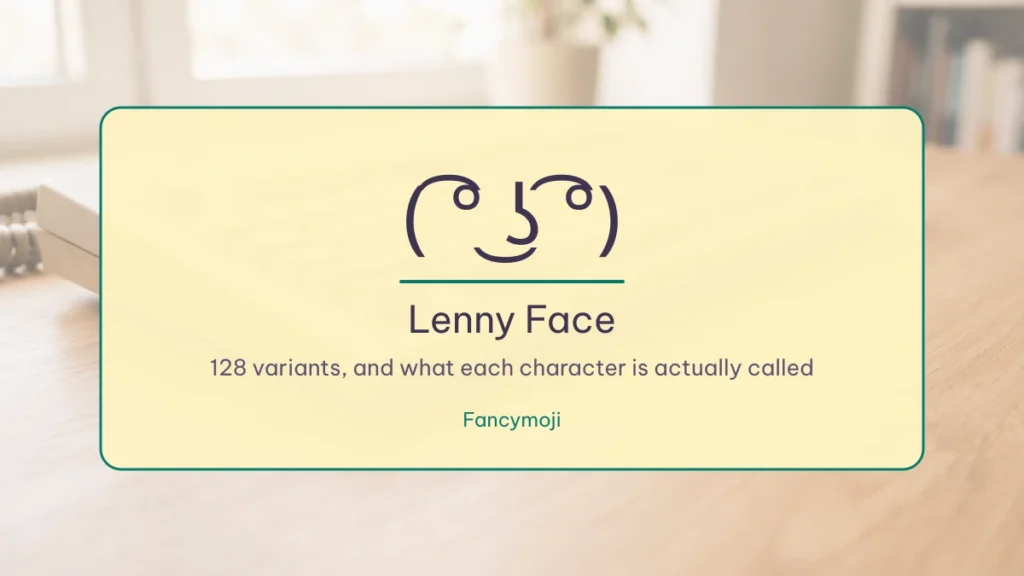
The Lenny face ( ͡° ͜ʖ ͡°) is a text face built from ordinary Unicode characters — no image, no emoji. It reads as a knowing smirk: the raised-eyebrow look you send when something could be taken a second way. Tap any face below to copy it.
What the Lenny face means
It marks the sentence before it as suggestive, sarcastic or knowingly loaded. That is the whole job. It is the text equivalent of raising one eyebrow after saying something — it does not add information, it changes how the previous line should be read.
The three registers it is actually used in, in rough order of frequency:
| Register | What it does | Example use |
|---|---|---|
| Innuendo | flags a double meaning the writer wants noticed | after a line that could be read two ways |
| Smugness | marks a small victory or an obvious point landed | after winning an argument on a technicality |
| Deadpan | signals the whole message is not serious | after a deliberately absurd claim |
What it is not: it is not friendly, not warm, and not neutral. Sending it in a sincere conversation reads as mockery even when that was not the intent. If you want a warm smirk rather than a loaded one, ( ͡° ͜ᴥ ͡°) and ( ͡ᵔ ͜ʖ ͡ᵔ) soften it considerably — the eyes do that work, as explained in our guide to what a kaomoji is and how to read one.
What each character is actually called
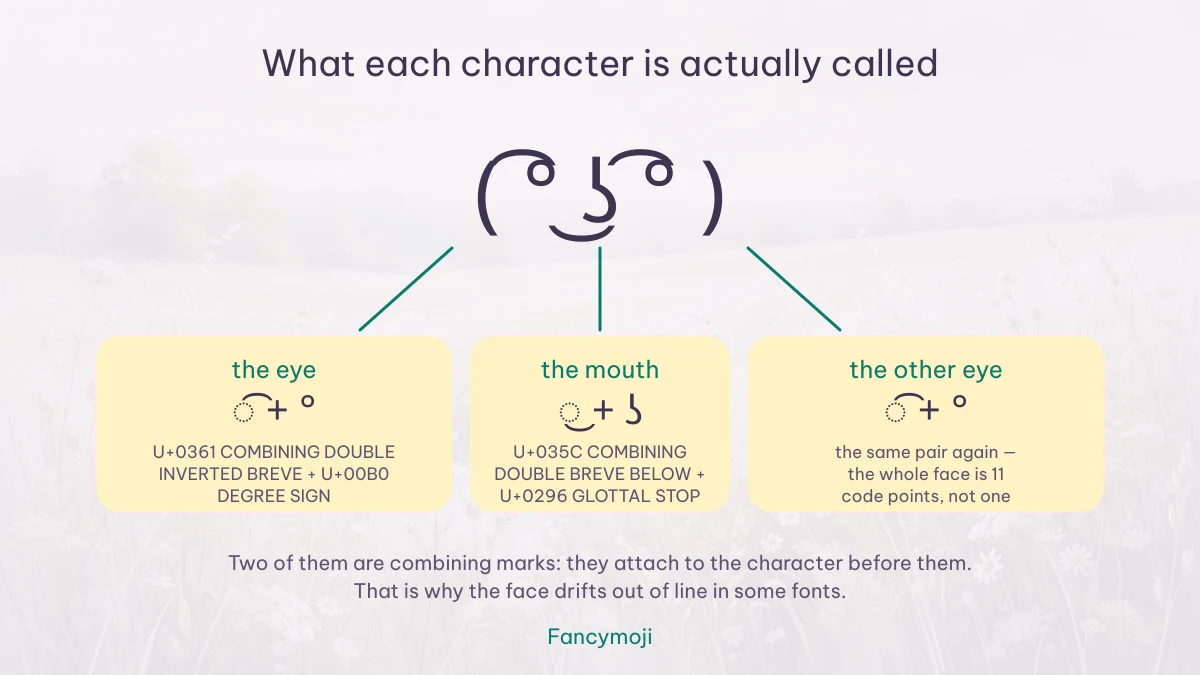
This is the question every Lenny page gets asked and almost none answer. The face is not one character. It is eleven code points, and each has a formal Unicode name:
| Character | Code point | Official Unicode name | Category |
|---|---|---|---|
| ( | U+0028 | LEFT PARENTHESIS | punctuation |
| ͡ | U+0361 | COMBINING DOUBLE INVERTED BREVE | non-spacing mark |
| ° | U+00B0 | DEGREE SIGN | symbol |
| ͜ | U+035C | COMBINING DOUBLE BREVE BELOW | non-spacing mark |
| ʖ | U+0296 | LATIN LETTER INVERTED GLOTTAL STOP | lowercase letter |
| ) | U+0029 | RIGHT PARENTHESIS | punctuation |
So the eyebrows are not eyebrows — they are combining marks, characters designed to attach to the character before them. U+0361 normally draws a tie over two letters in phonetic transcription. U+0296 is a real consonant symbol from the International Phonetic Alphabet. The face is an accident of typography being borrowed for a joke, which is exactly why it renders differently across fonts.
You can verify all of this yourself: paste the face into any Unicode inspector and it will list the same eleven code points.
128 variants to copy
Grouped by what they actually change, not dumped in one block. Every one below is a real, working composition — tap to copy.
The classics 40
The original and its closest relatives. Same eye on both sides, mouth swapped. If you only ever use one, use the first.
Mismatched eyes 21
One eye different from the other. This is the sceptical, unimpressed register — the face reads as if it is squinting at you.
With arms 24
Arms turn a still face into a gesture: flexing, shrugging, pointing. Good when the face is the whole message.
Framed 18
Tibetan and CJK brackets wrapped around the face. Heavier on the eye and more likely to break on old devices, so use where you know the font is modern.
Stretched 12
Extra spacing pushes the eyes apart. Reads as slow, deliberate, drawn-out — the comic-timing version.
The wild ones 13
Odd variants collected from the wider text-face pool. Less standard, more memorable.
Build your own: the eye-mouth-eye formula
Build one now
Pick eyes, a mouth, cheeks and arms — the same builder that runs on the Fancymoji home page.
tap a piece to drop it into the crib and copy it
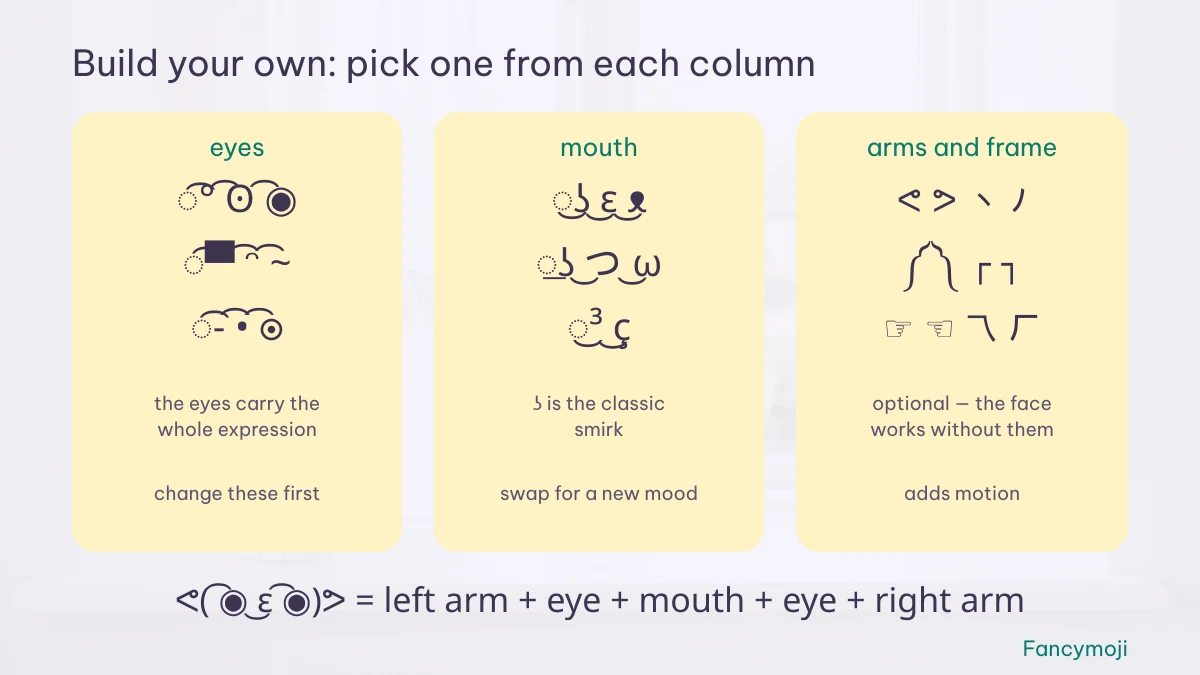
Every face above follows one pattern: ( eye mouth eye ), with optional arms outside the brackets. Pick one from each column and you have a face nobody else is using.
| Part | Options | What changes |
|---|---|---|
| Eyes | ͡° ͡ʘ ͡◉ ͡▀ ͡ᵔ ͡~ ͡- ͡• ͡๏ | the entire expression — start here |
| Mouth | ͜ʖ ͜ε ͜ᴥ ͟ʖ ͜つ ͜ω ͜³ | smirk, kiss, animal, open-mouthed |
| Arms | ᕙ ᕗ · ヽ ノ · ┌ ┐ · ☞ ☜ · 乁 ㄏ | adds motion; optional |
| Frame | ( ) · ༼ ༽ · ⦅ ⦆ · ⟨ ⟩ | the head shape |
The rule worth remembering: change the eyes first. Hold the mouth still and swap only the eyes and the mood moves completely; do it the other way round and the face barely shifts. That is true of kaomoji generally, not just this one.
How to type it on PC, Mac, iPhone and Android
Honest answer first: on a phone there is no key combination for it. Copying is the normal way, and setting up a shortcut is the only way to make it fast.
| Device | How |
|---|---|
| iPhone / iPad | Settings → General → Keyboard → Text Replacement. Paste the face in Phrase, type something like lenny as the Shortcut. Typing lenny then expands to the face anywhere on the device. |
| Android | Gboard: Settings → Personal dictionary → pick a language → add the face with a shortcut word. Samsung Keyboard has the same feature under Text shortcuts. |
| Windows | No single key. The characters can be entered one at a time by Alt code (the eyebrow is Alt+865, the degree sign Alt+248, the mouth Alt+860 then Alt+662), but copying is faster. For repeat use, a text-expander is the practical route. |
| Mac | System Settings → Keyboard → Text Replacements — the same idea as iOS, and it syncs across devices signed into the same Apple account. |
The Alt-code route is what most sites list, and it does work in some Windows applications — but it is unreliable outside them and does nothing on macOS or mobile. A text replacement takes thirty seconds and works everywhere on that device.
Why it sometimes looks broken
If the eyebrows sit too far left, overlap the brackets, or drift onto the wrong character, nothing is wrong with the text you copied. It is a font-rendering result, not a corrupted character.
The reason is in the anatomy above: U+0361 and U+035C are combining marks with an unusual property — they are designed to span two characters, drawing an arc across a pair. A font decides for itself how wide that arc is and where to anchor it. Fonts with good coverage place it neatly; fonts without a specific rule fall back to a default position, and the face drifts.
Three practical consequences:
- The same face looks different in different apps on the same phone, because each app may use a different font.
- Monospace fonts handle it worst — every character gets identical width, so a mark meant to span two characters has nowhere sensible to go. That is why it looks wrong in code editors and terminals.
- It is still correct when it looks wrong. The recipient’s device may draw it perfectly even when yours does not. Do not “fix” it by deleting the marks — that removes the eyebrows entirely.
Lenny face actions: hug, wave and dance
Add arms and the smirk becomes a gesture. Each one below copies in one tap; the hug and the wave read as friendly teasing, the dance as a victory lap.
| Action | Copy |
|---|---|
| Hug | |
| Hug, one arm | |
| Wave | |
| Wave, both hands | |
| Dance | |
| Dance with notes | |
| Thumbs up | |
| Cheers |
Where the Lenny face comes from
The face is generally traced to Western forum and imageboard culture in the early 2010s, not to the Japanese message boards behind classic kaomoji. Know Your Meme keeps an entry on it at knowyourmeme.com/memes/lenny-face. Sources differ on the exact first post, so this page gives no exact date.
The four famous faces
Lenny sits beside three other text faces everyone recognises: the shrug for “no idea”, the table flip for rage and the look of disapproval for a flat stare. For softer faces, try cute kaomoji, or browse the whole library on Fancymoji.
Is the Lenny face a dead meme?
As a meme — the 2014-era forum ritual of spamming it in comment threads — yes, that moment has passed. As a piece of punctuation, no: it settled into normal use the way ¯\_(ツ)_/¯ did. It stopped being a joke about itself and became a tone marker people reach for without thinking about where it came from.
That is the usual life cycle for text faces. The ones that survive are the ones that do a job no punctuation mark does. English has no character for “read that last line again”; this face fills the gap, so it stays useful long after the trend around it ended.
Frequently asked questions
What is this called: ͡ ͜ʖ ͡
Individually, those three are COMBINING DOUBLE INVERTED BREVE (U+0361), COMBINING DOUBLE BREVE BELOW (U+035C) and LATIN LETTER INVERTED GLOTTAL STOP (U+0296). Together with two degree signs and a pair of brackets they form what is commonly called the Lenny face. It is also known as a “text face” or, when arms are attached, a “donger”.
What does ( ͡° ͜ʖ ͡°) mean?
It marks the message before it as suggestive, smug or deadpan — a raised eyebrow rendered in text. It carries tone, not information, and it reads as mocking in a sincere conversation, so it is best kept for jokes and banter.
How do I type the Lenny face on an iPad?
There is no key for it. Copy it from this page, then go to Settings → General → Keyboard → Text Replacement, paste it as the Phrase and set a short Shortcut such as lenny. After that, typing lenny anywhere on the iPad expands to the face.
Why does the Lenny face look misaligned on my screen?
Because two of its characters are combining marks that span two characters, and each font decides where to draw that span. Monospace fonts handle it worst. The text itself is intact — it will very likely render correctly for whoever you send it to.
Is the Lenny face the same as a kaomoji?
It is a kaomoji in the broad sense: a face made of text characters, read upright rather than sideways. It differs from traditional Japanese kaomoji in origin — those came from Japanese message boards in the 1980s, while this one emerged from Western forum culture much later and leans on IPA and combining marks rather than kana.
Can I use it in a username?
Almost never. Username fields normally accept only letters, numbers, underscores and full stops, and combining marks are among the first things they reject. Display names and bios are usually fine. Chat messages always work.