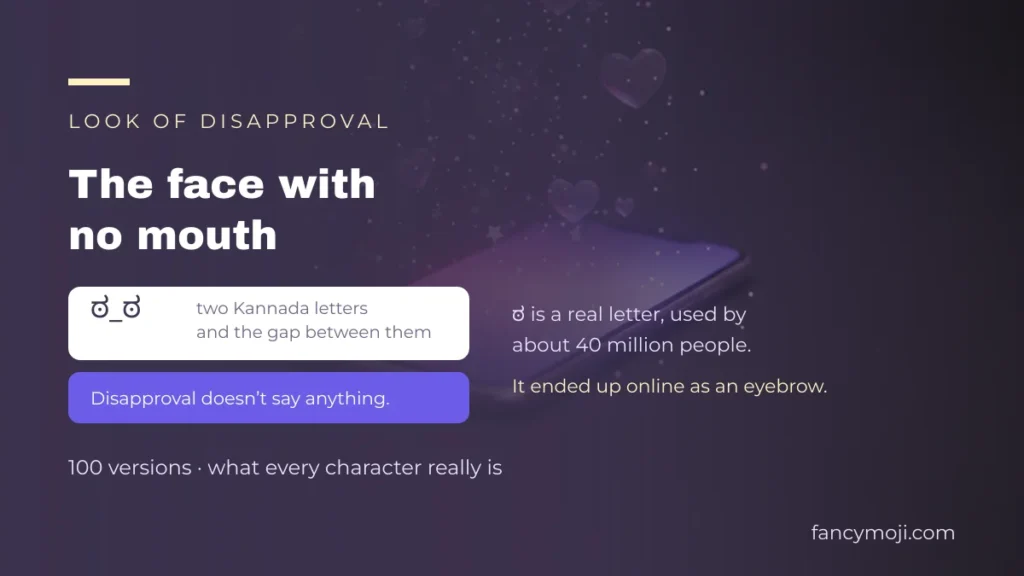
The Look of Disapproval, written ಠ_ಠ, is a text face of a stern, mouthless stare. It is made of two Kannada letters (ಠ, U+0CA0) with an underscore between them, and it is used to show quiet disapproval.
ಠ is a real letter, from a real alphabet, used by about forty million people — and it ended up on the internet as an eyebrow. The Look of Disapproval is two Kannada letters with an underscore between them, and it is the most elegant thing in the whole kaomoji tradition: ಠ_ಠ has no mouth, because disapproval does not say anything. Here are 100 versions to copy, what every character in them actually is, and the one thing to check before you send it.
100 disapproving faces to copy
All of these are ordinary text characters — nothing here is an image, so what you send is what arrives.
The original and its close variants 20
Two Kannada letters and one piece of punctuation. The face has no mouth — and that is the entire joke, because disapproval does not say anything.
The rest of the family 20
ಥ is the crying one, ಡ is softer, ರ is rounder. Each is a different Kannada letter, and each changes the mood without changing the structure.
With arms 20
ლ and ༼ ༽ come from Georgian and Tibetan. When you add arms, the silence stops being the point — these read as loud.
Faces that do the same job 20
Same register, different scripts: Latin, Korean, Arabic, geometric shapes. Useful when Kannada does not render on the other person’s device.
The parts 20
Four eyes, one mouth, and a set of arms. Any eye plus any mouth works.
What ಠ actually is
Every part of this face is borrowed from a language that has nothing to do with the internet.
| Character | Official name | Where it comes from |
|---|---|---|
| ಠ (U+0CA0) | KANNADA LETTER TTHA | Kannada, the language of Karnataka in southern India — roughly 40 million speakers |
| ಥ (U+0CA5) | KANNADA LETTER THA | The same alphabet. The extra loop reads as a tear |
| ಡ (U+0CA1) | KANNADA LETTER DDA | Also Kannada. Softer, less accusatory |
| 益 (U+76CA) | CJK UNIFIED IDEOGRAPH-76CA | A Chinese character meaning «benefit» — borrowed purely because it looks like gritted teeth |
| ‿ (U+203F) | UNDERTIE | A linguistics symbol for joining two sounds. Here it is a smile |
| ლ (U+10DA) | GEORGIAN LETTER LAS | Georgian. It became the raised arms in ლ(ಠ_ಠლ) |
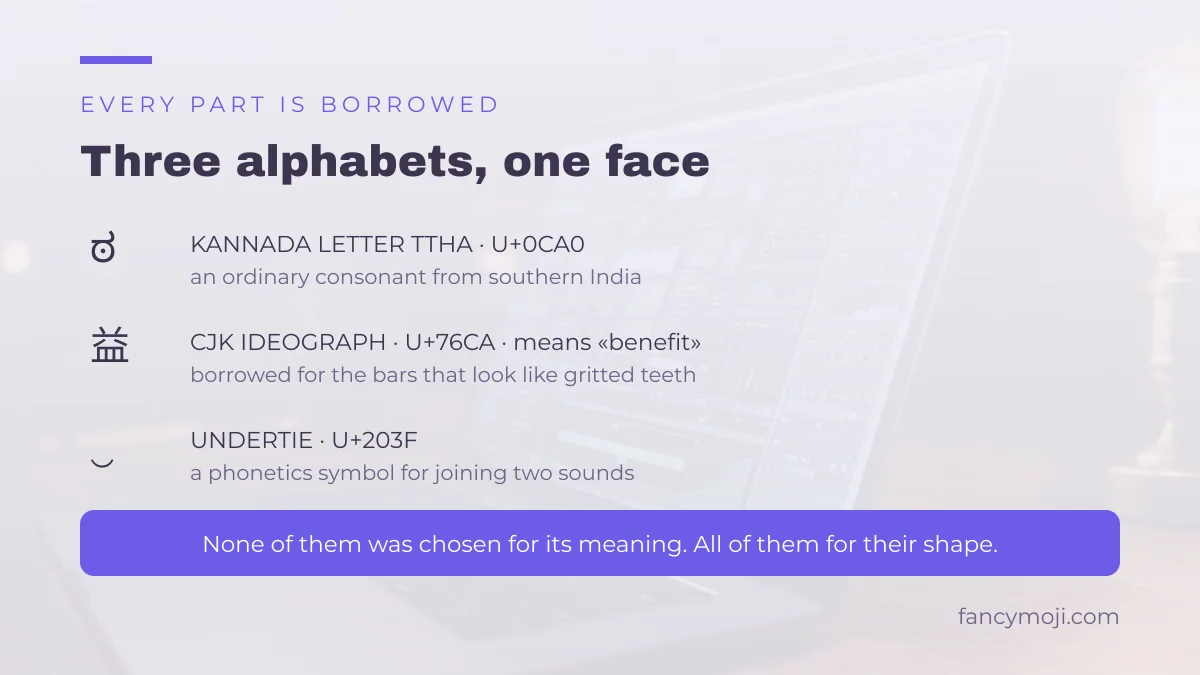
The Chinese character is the one worth pausing on. 益 means «benefit» or «increase» — it appears in perfectly ordinary words about profit and advantage. On the internet it is a clenched, furious mouth, and it got that job because of the horizontal bars across the middle. Nobody chose it for its meaning; it was chosen for its shape, the same way ಠ was.
And ‿ is a phonetics symbol: linguists use the undertie to show that two sounds run together. Turn it upside down in your head and it is a grin, which is how ಠ‿ಠ became the unsettling smile.
The face with no mouth
Look at the first group again. ಠ_ಠ is two eyes and a flat line — and the flat line is not a mouth, it is the space between the eyes. There is no mouth in this face at all.
That is why it works so much better than an angry emoji for the specific thing it does. Compare:
- 😠 says «I am angry». A statement, with a face making it.
- ಠ_ಠ says nothing. It is a person looking at you and declining to comment. That is a different, and much more effective, register.
The variants prove the rule by breaking it. Add a mouth — ಠ益ಠ — and it stops being disapproval and becomes rage. Add arms — ლ(ಠ益ಠლ) — and it becomes a person shouting. Silence is the whole mechanism, and every addition spends some of it.
The one thing to check before sending it
Unlike the shrug, this face has no backslash, so no app eats part of it. Its weak point is different: it needs a Kannada font on the other person’s device.
- Modern phones and computers are fine. Kannada ships with the standard font sets on iOS, Android, Windows and macOS.
- Older devices and some cut-down systems are not. There ಠ arrives as an empty box, and the person sees □_□ — which, annoyingly, still looks a bit like a face, so they may not realise anything is wrong.
- Anywhere a font is restricted — an e-reader, a point-of-sale display, an embedded system, a game with its own font — assume it will not render.
If you need something that works everywhere, the fourth group above is the answer: (¬_¬) and (-_-) use Latin and Japanese characters that every device has, and they carry almost the same tone.
One more thing worth knowing: screen readers announce ಠ as a Kannada letter, not as an eye. Someone listening to your message hears the name of an Indian consonant twice with an underscore in between. In anything that has to be accessible, write the words.
When it lands, and when it does not
This face is unusually good at one thing and unusually bad at another, and the line between them is not obvious.
| Situation | Works? | Why |
|---|---|---|
| Reacting to something absurd that happened | Yes | Directed at the situation. Everyone can join in |
| A friend has said something ridiculous | Yes | Teasing, and clearly theatrical |
| Replying to a colleague’s decision | No | Silent judgement of a person, in writing, on the record |
| Answering a genuine question | No | It reads as «I am not going to explain» |
| A code review or a ticket | No | Someone reads it months later without the tone |
| Your own mistake | Yes | Turning it on yourself is where it is funniest |
The pattern is the same one that governs the table flip: fine about a situation, risky about a person. The difference is that the table flip is loud and obviously a performance, while ಠ_ಠ is quiet — and quiet judgement is harder to take as a joke.
Frequently asked questions
What is ಠ_ಠ called?
The Look of Disapproval. Some people call it the disapproval face or the judging face; all three refer to the same thing.
What language is ಠ from?
Kannada, spoken mainly in the Indian state of Karnataka by roughly forty million people. ಠ is the letter TTHA, an ordinary consonant — it was borrowed for its shape, not its sound.
How do I type ಠ_ಠ?
Copy it from here. There is no keyboard shortcut unless you install a Kannada keyboard, and even then you would be typing two consonants on purpose. If you use it often, save it as a text replacement.
What is the 益 in ಠ益ಠ?
A Chinese character meaning «benefit» or «increase». It has nothing to do with anger — it was picked because the horizontal bars look like gritted teeth.
Why does it show as a box on some phones?
Because that device has no Kannada font. Your text is intact; the phone simply cannot draw the letter. For people you do not know, use (¬_¬) instead — it carries the same tone with characters every device has.
What is ಥ_ಥ?
The crying version. ಥ is a different Kannada letter, THA, and the extra loop reads as a tear. Same structure, opposite mood.
The other faces with a story of their own: the Lenny face, the shrug and the table flip. If the words themselves are confusing, start at kaomoji vs emoji vs emoticon or what is a kaomoji. The whole library is on Fancymoji.