Emoticons such as 🙂 are made of plain punctuation, kaomoji such as (^_^) are upright faces built from characters of many alphabets, and emoji such as 😊 are single characters that each device draws in its own style.
The three words get used as if they meant the same thing, and they do not — and the biggest surprise is that «emoji» has nothing to do with «emotion». It is a Japanese word meaning picture character, and the resemblance to «emoticon» in English is a coincidence. Here is what actually separates the three, why one of them looks different on every phone while the other two never do, and which one to use where.
The three, side by side
| Emoticon | Kaomoji | Emoji | |
|---|---|---|---|
| Example | 🙂 | (^_^) | 😊 |
| Made of | Punctuation, ASCII only | Characters from many alphabets | One character of its own |
| How you read it | Tilt your head left | Upright, as it is | Upright |
| How many characters | Three | Five, sometimes twenty | One |
| Who draws it | Nobody — it is just text | Nobody — it is just text | Your device |
| Looks the same everywhere? | Yes | Yes | No |
| Where it came from | United States, 1982 | Japan, late 1980s | Japan, late 1990s |
| Blocked in name fields? | Often survives | Often survives | Almost always blocked |
The row that matters most in practice is the sixth. An emoji is a request, not a picture: the character says «smiling face with smiling eyes» and every device draws its own. That is why the same message can read warm on one phone and slightly manic on another. A kaomoji is not drawn by anyone — it is the characters themselves, so what you send is exactly what arrives.
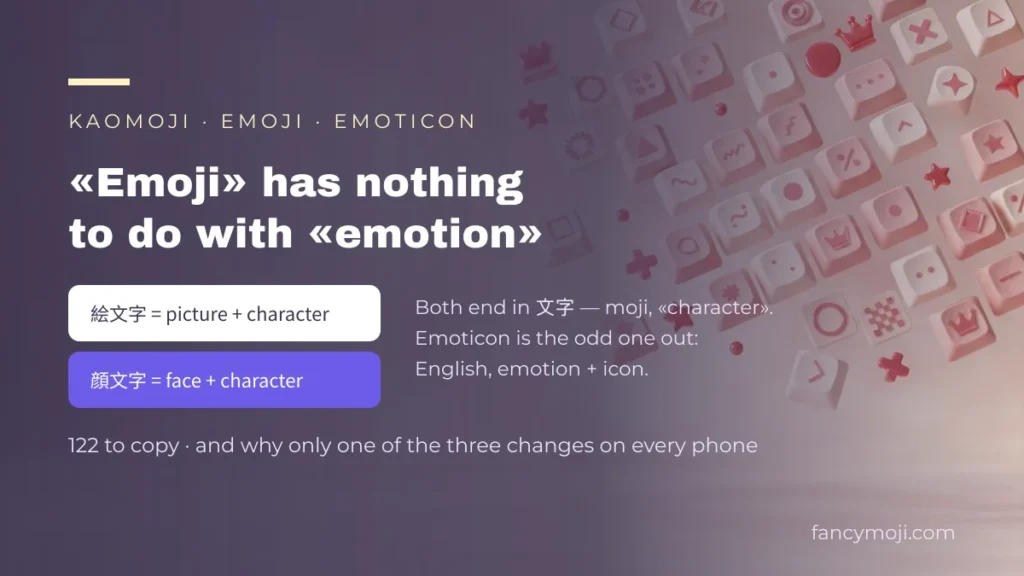
«Emoji» does not come from «emotion»
This is the fact that reorganises everything else, and almost nobody knows it.
| Word | Japanese | Literally |
|---|---|---|
| Emoji | 絵文字 | e = picture · moji = character → «picture character» |
| Kaomoji | 顔文字 | kao = face · moji = character → «face character» |
| Emoticon | — | English: emotion + icon |
Emoji and kaomoji are siblings: both end in 文字, moji, meaning character. One is a picture-character, the other a face-character. Emoticon is the odd one out — an English coinage from a completely different root that just happens to start with the same three letters as emoji.
Which also settles a small argument people have: the plural of emoji. Japanese has no plural form, so «emoji» is both. «Emojis» has become normal in English and is not wrong — it is just an English ending on a Japanese word, the same way «two sushis» would be.
All three, to copy
The difference is easier to feel than to read about. Tap any of these.
Emoticons — the Western kind 36
Punctuation only, read with your head tilted left. Every one of these is pure ASCII, which is why they still work in systems from thirty years ago.
Kaomoji — the Japanese kind 36
Read upright, no tilting. The eyes carry the emotion and the mouth barely changes — the opposite of how a Western emoticon works.
Emoji — one character each 30
Each of these is a single Unicode character that your device draws as a picture. That is why they look different on an iPhone and on Android, and why the two above do not.
The parts kaomoji are built from 20
Ordinary characters borrowed for their shape — a Japanese letter, a Braille dot, a mathematical operator. None of them was designed to be part of a face.
Why one is sideways and the other is not
Look at the two lists again and you will see the real difference, and it is not the tilt — it is where the emotion is kept.
- In a Western emoticon, the mouth does the work. 🙂 and 🙁 have identical eyes; only the mouth flips. That is why they have to be read sideways: the mouth needs the wide axis.
- In a kaomoji, the eyes do the work. (^_^), (>_<), (T_T), (¬_¬) — the mouth is the same underscore in all four. Only the eyes change, and the face stays upright because eyes sit side by side.
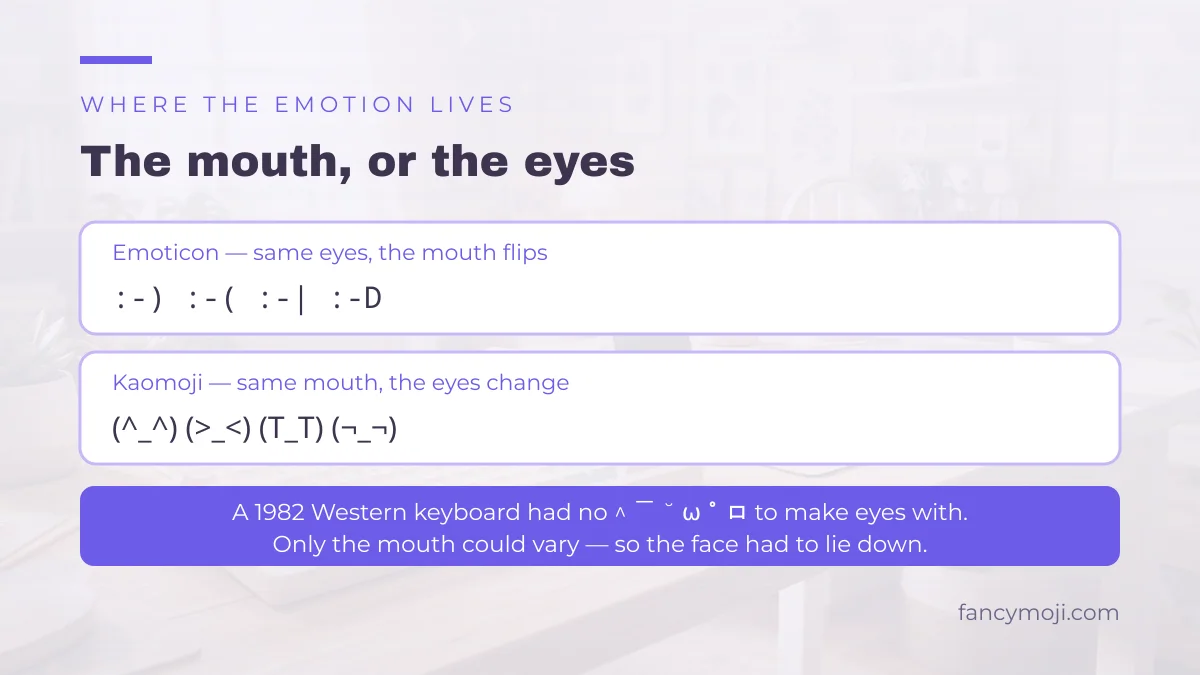
This is often explained as a cultural difference in how faces are read, and that may well be true. But there is also a plain mechanical reason: Japanese keyboards had far more characters to draw eyes with. ^  ̄ ˘ ω ゚ ° ロ ᴥ Д — a Western keyboard in 1982 had none of those. With only punctuation available, the mouth was the only part you could vary, and the face had to go sideways to fit.
One character or twenty: what it changes
This is where the difference stops being trivia and starts costing you something.
| What you send | Characters it really is | What that means |
|---|---|---|
| 😊 | 1 | Cheap in a character limit — but the device redraws it |
| 🙂 | 3 | Survives literally anywhere, including very old systems |
| (^_^) | 5 | Same everywhere, but eats five characters of a bio |
| 🤦♀️ | 4 | Looks like one emoji. It is a face, a joiner and a gender sign glued together |
| 👩👩👧👦 | 7 | Four people and three invisible joiners — the most expensive character on your keyboard |
The last two rows are the ones that catch people out. Some emoji are not one character at all. They are several, stitched together with an invisible «zero width joiner», and a field that counts characters counts every piece. A 150-character bio with three family emoji in it has already spent twenty-one characters on three pictures.
It also explains the broken ones you sometimes see: if a device does not know the combination, it shows the pieces separately — two women, a girl and a boy in a row instead of a family. Nothing is corrupted; the receiving phone simply never learned that particular sequence.
Which one to use where
| Where | Best choice | Why |
|---|---|---|
| Message to a friend | Any | Nothing gets stripped, nothing gets counted |
| Display name or bio | Kaomoji | Survives, and looks identical on the reader’s device |
| @username or handle | None | Handles allow letters, digits and one or two punctuation marks |
| Game name field | Emoticon or a short kaomoji | Emoji are usually rejected; long kaomoji hit the length limit |
| Commit message, ticket, document | Emoticon | Plain ASCII, no font surprises, no encoding surprises |
| Anything read aloud by a screen reader | Emoji | It has one name; a kaomoji is read out character by character |
That last row is worth sitting with, because it reverses the usual advice on this site. For accessibility the emoji wins easily: 😊 is announced as «smiling face with smiling eyes», one short phrase. (^_^) is announced as parenthesis, circumflex, low line, circumflex, parenthesis. Everywhere else the kaomoji is the more reliable of the two — but not there.
Frequently asked questions
Are emoticons and kaomoji the same?
No. Both are made of ordinary text, but an emoticon is punctuation read sideways — 🙂 — while a kaomoji is read upright and uses characters from many alphabets — (^_^). In an emoticon the mouth carries the emotion; in a kaomoji the eyes do.
Does «emoji» come from «emotion»?
No, and that is the most common misunderstanding about the word. Emoji is 絵文字 in Japanese: e for picture, moji for character. The English resemblance to «emotion» is a coincidence.
Is a kaomoji an emoji?
No. An emoji is one Unicode character that your device draws as a picture; a kaomoji is several ordinary characters arranged to look like a face. That is also why an emoji looks different on every phone and a kaomoji does not.
Which one works in a username?
None of them. Handles accept only letters, digits and usually a dot and an underscore. Display names and bios are separate fields and normally accept all three.
Why does the family emoji sometimes fall apart?
Because it is not one character but seven, joined by invisible connectors. If the receiving device does not know that particular combination, it shows the people separately instead of as a group.
How do you pronounce «kaomoji»?
Roughly kah-oh-MOH-jee, four syllables, with each vowel sounded — ka-o-mo-ji. Not «kow».
If you want the faces themselves rather than the theory, start at what is a kaomoji, or go straight to cute kaomoji and sad kaomoji. The three faces with their own histories are the Lenny face, the shrug and the table flip. The whole library is on Fancymoji.